Humming Bee Breath
Literal meaning: Bee-like; the humming of a bee
A gentle nasal inhale followed by a long, comfortable humming exhale. The sound creates a clear inward focus without requiring breath retention; this page guides the simple hands-free form and documents the more demanding textual and lineage variations separately.
Draft — pending review by a qualified teacher.
The safety framing and translations are editorial drafts. Read conservatively and do not treat this page as medical advice.
Author: Editorial draftReviewer: pendingLast reviewed: not yet reviewed
Who it’s for / not for
May suit
- People who find a soft, steady sound easier to follow than silent breath counting.
- Beginners seeking a short, low-intensity settling practice without breath retention.
- Practitioners preparing to sit quietly, meditate, or transition out of a busy period.
Pause or seek guidance if
- Active ear infection, severe ear pain, or a recent ear procedure without clinical clearance
- Ear or sinus pressure, sound-sensitive headache, tinnitus, or marked sound sensitivity
- Acute shortness of breath, a respiratory flare, or feeling unwell at rest
- A condition for which a clinician has advised limiting breath-control or vocal exercises
- Any plan to add breath retention, strong bandhas, or prolonged sensory-closing mudrā
Safety
Use the gentlest form, keep every breath comfortable, and stop rather than pushing through symptoms.
Contraindications and cautions
Active ear infection, severe ear pain, or a recent ear procedure without clinical clearance
Wait until the condition has resolved or the clinician responsible for your care says humming is appropriate.
Ear or sinus pressure, sound-sensitive headache, tinnitus, or marked sound sensitivity
Use a very soft hum and stop if symptoms increase. Persistent or one-sided symptoms deserve professional assessment.
Acute shortness of breath, a respiratory flare, or feeling unwell at rest
Do not lengthen or sound the exhale through active symptoms. Return to ordinary breathing and seek appropriate care.
A condition for which a clinician has advised limiting breath-control or vocal exercises
Ask whether a brief, quiet, no-retention form is appropriate for you.
Any plan to add breath retention, strong bandhas, or prolonged sensory-closing mudrā
These are different, more demanding practices. Learn them from a qualified teacher, especially during pregnancy or with cardiovascular, respiratory, neurological, or eye-pressure concerns.
Stop if you feel…
- Ear pain, increasing ear or sinus pressure, a spike in ringing, or sound that feels physically distressing.
- Throat pain, voice strain, jaw pain, or a headache that begins or worsens with humming.
- Dizziness, faintness, tingling, unusual breathlessness, panic, or a strong urge to gasp.
- Chest pain, pressure, palpitations, or any new alarming symptom—stop and seek appropriate medical help.
Read the Safety Center before practising retention or forceful breathwork.
Hand position & posture

Practice
This player runs only the protocol marked as suitable for guidance. Stay within a comfortable range and stop at any warning sign above.
Humming Bee Breath
Gentle humming · no retention
Prepare
Relax your jaw, face, and shoulders.
How to practise
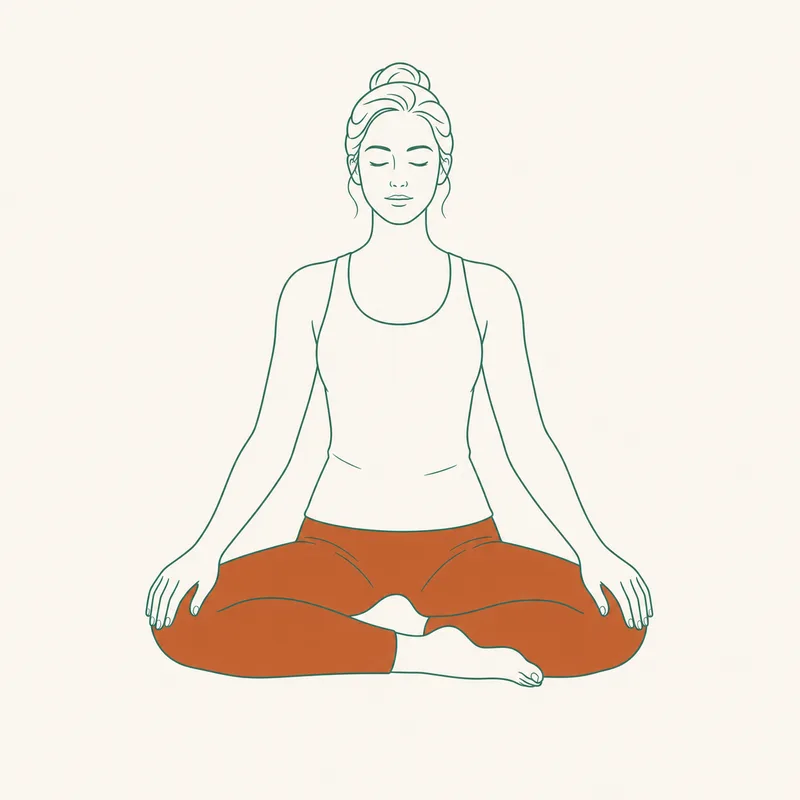
Choose a quiet place and sit upright in a position you can maintain without effort. Rest the hands on the thighs and soften the shoulders, face, and belly.
Take two or three natural breaths. Keep the jaw relaxed, the teeth slightly apart, and the lips resting together without clenching.
Inhale gently through both nostrils. The beginner version uses a quiet inhale—do not try to reproduce the forceful or sounding inhalation found in some textual descriptions.
As you exhale, make a smooth “mmm” hum at an easy pitch. Feel vibration around the lips, face, or head without chasing a particular sensation.
Let the hum end while some breath still feels available. Do not squeeze the throat, collapse the chest, or push out the last air.
Inhale naturally and repeat for five to eight rounds. Keep the sound soft enough that the throat and ears remain comfortable.
After the final exhale, sit in silence for several natural breaths and notice the contrast between sound and quiet.
Common mistakes
- Humming as loudly as possible. Volume is not the goal; a smooth, sustainable vibration matters more.
- Clenching the jaw, pressing the teeth together, or tightening the throat to manufacture the sound.
- Extending the exhale until there is air hunger, strain, or a forced final push.
- Adding breath retention because Bhrāmarī appears among classical kumbhakas. The guided version intentionally contains no retention.
- Pushing fingers into the ear canals or pressing the eyeballs in a face-closing mudrā. The hands-free version is complete on its own.
Variations by lineage
These differences are preserved rather than flattened into a single supposedly universal method.
Haṭha Yoga Pradīpikā
Verse 2.68 describes a sounding, quicker inhale likened to a male bee and a very slow sounding exhale likened to a female bee. Most modern beginner teaching—including this player—uses a quiet nasal inhale and hums only on the exhale.
Svātmārāma, Haṭha Yoga Pradīpikā 2.68
Gheraṇḍa Saṃhitā
Verses 5.78–82 describe closing the ears, retaining after inhalation, and attending to inner sounds at night; 7.9–10 describe a slow Bhrāmarī exhale in a meditation context. This is a sensory-withdrawal and retention practice, not simply the hands-free hum guided here.
Gheraṇḍa Saṃhitā 5.78–82 and 7.9–10
B. K. S. Iyengar
Light on Prāṇāyāma teaches deep Ujjāyī-style inhalation and a humming exhalation, explicitly advises against retention in Bhrāmarī, and allows Śanmukhī Mudrā without Jālandhara Bandha.
B. K. S. Iyengar, Light on Prāṇāyāma, chapter 21
What the evidence says
Evidence for technique-specific health effects remains limited. Traditional claims describe a yoga framework; mechanistic findings explain a possible process; small clinical studies are not proof of treatment.
| Claim or finding | What it means | Citation |
|---|---|---|
| Traditional | ||
| The Haṭha Yoga Pradīpikā associates repeated Bhrāmarī with an experience of inward joy or absorption. | This is a traditional contemplative claim, not a measured clinical outcome. | Haṭha Yoga Pradīpikā 2.68 |
| Mechanistic | ||
| Humming can sharply increase nasal nitric-oxide output during the hum compared with a quiet exhale. | A physiology experiment in 10 healthy adults found a roughly 15-fold increase during humming. It was not a Bhrāmarī treatment trial and established no therapeutic benefit. | Weitzberg E, Lundberg JON. Am J Respir Crit Care Med. 2002;166(2):144–145. doi:10.1164/rccm.200202-138BC |
| Preliminary clinical | ||
| One randomized study reported improved spirometry after a high-dose, 12-week Bhrāmarī program in healthy adolescents. | The intervention was about 45 minutes, five days a week—far more than this player session. The finding does not show that a brief practice treats respiratory disease. | Kuppusamy M et al. Anc Sci Life. 2017;36(4):196–199. doi:10.4103/asl.ASL_220_16 |
Sources
- 1.
Svātmārāma, Haṭha Yoga Pradīpikā
2.68
Contrasts a sounding inhale and a slow sounding exhale; its closing language is a traditional contemplative claim.
- 2.
Gheraṇḍa Saṃhitā
5.78–82 and 7.9–10
Describes ear-closing, retention, inner sound, and a separate slow-exhale meditation instruction.
- 3.
B. K. S. Iyengar, Light on Prāṇāyāma: The Yogic Art of Breathing
Chapter 21, “Bhrāmarī Prāṇāyāma”
Modern lineage reference for humming on exhalation, no retention, and an optional Śanmukhī Mudrā form.
- 4.
Swami Satyananda Saraswati, Asana Pranayama Mudra Bandha, 4th revised edition
Yoga Publications Trust, 2008; “Bhramari Pranayama”
A modern staged practice reference; retained and mudrā variations require separate instruction.
- 5.
Weitzberg E, Lundberg JON. Humming greatly increases nasal nitric oxide.
Open reference ↗Mechanistic study in 10 healthy adults; not a clinical trial of Bhrāmarī.
- 6.
Kuppusamy M, Dilara K, Ravishankar P, Julius A. Effect of Bhrāmarī Prāṇāyāma Practice on Pulmonary Function in Healthy Adolescents: A Randomized Control Study.
Open reference ↗Twelve-week, high-dose program in 90 healthy adolescents; preliminary and not directly comparable with the brief player protocol.