Ocean Breath
Literal meaning: Victorious or uplifting breath
A gentle narrowing at the throat gives the breath a soft, ocean-like sound and naturally slows and lengthens it. This page guides a light, no-retention version with an equal in-and-out rhythm; classical forms add retention (kumbhaka) and jālandhara bandha and are best learned with a qualified teacher.
Draft — pending review by a qualified teacher.
The safety framing and translations are editorial drafts. Read conservatively and do not treat this page as medical advice.
Author: Editorial draftReviewer: pendingLast reviewed: not yet reviewed
Who it’s for / not for
May suit
- People who want an audible cue to keep the breath slow, smooth, and even during seated practice or movement.
- Practitioners who find it easier to lengthen the exhale when the breath makes a soft, steady sound to follow.
- Beginners looking for a warming, focusing breath that does not require any breath-holding.
- Those preparing the breath before meditation who prefer gentle throat resonance to nostril-closing techniques.
Pause or seek guidance if
- Acute shortness of breath, a respiratory flare, or feeling unwell at rest
- A sore throat, laryngitis, or any irritation of the throat or vocal cords
- A condition for which a clinician has advised limiting breath-control exercises
- Any plan to add retention (kumbhaka) or bandhas as in the classical form
Safety
Use the gentlest form, keep every breath comfortable, and stop rather than pushing through symptoms.
Contraindications and cautions
Acute shortness of breath, a respiratory flare, or feeling unwell at rest
Do not use paced or resistance breathing to push through active symptoms. Return to ordinary breathing and seek appropriate care.
A sore throat, laryngitis, or any irritation of the throat or vocal cords
The glottal narrowing works the throat directly. Rest the throat and wait until it is comfortable rather than practising through irritation.
A condition for which a clinician has advised limiting breath-control exercises
Ask the clinician who knows your condition whether this gentle, no-retention version is appropriate.
Any plan to add retention (kumbhaka) or bandhas as in the classical form
Learn retention-based ujjāyī from a qualified teacher — especially during pregnancy or with cardiovascular, respiratory, neurological, or eye-pressure concerns.
Stop if you feel…
- Dizziness, faintness, tingling, unusual breathlessness, or a strong urge to gasp.
- Chest pain, pressure, palpitations, or any new alarming symptom — stop and seek appropriate medical help.
- Throat pain, a raw or scratchy feeling, coughing, or a headache that begins or worsens during the practice.
Read the Safety Center before practising retention or forceful breathwork.
Hand position & posture
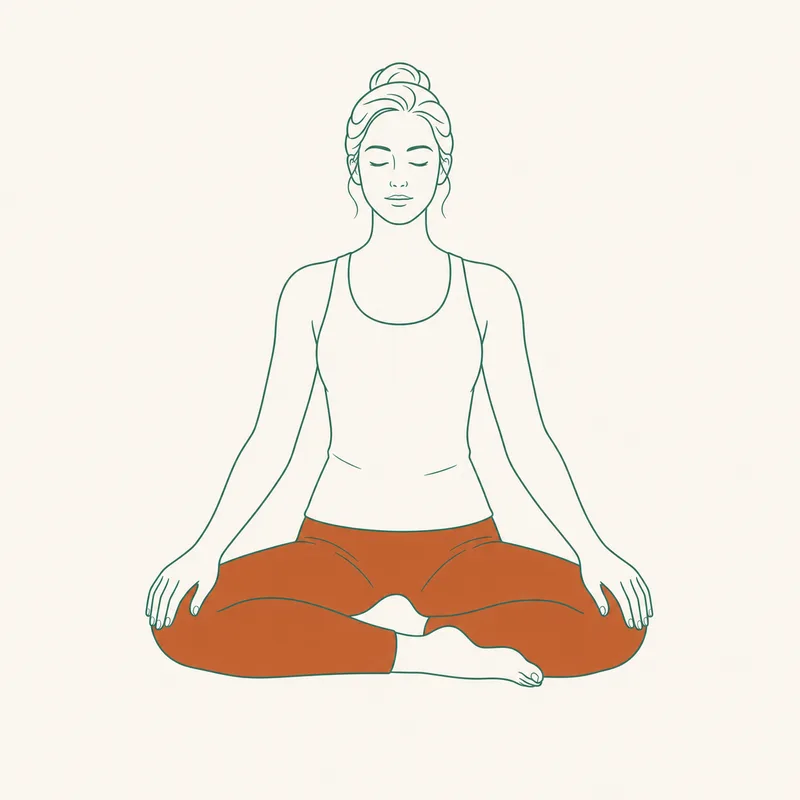
Practice
This player runs only the protocol marked as suitable for guidance. Stay within a comfortable range and stop at any warning sign above.
Ocean Breath
Gentle ocean breath · no retention
Prepare
Sit tall and soft. Relax the throat and listen to your natural breath.
How to practise
Sit in a stable, comfortable position with the head, neck, and chest upright but not rigid. Let the shoulders, jaw, and tongue relax, then take a few natural breaths.
First, find the throat action with the mouth open: exhale as if fogging a mirror or making a soft "haaa". Notice the gentle narrowing at the back of the throat that shapes the breath.
Now close the mouth and keep that same soft narrowing while breathing only through the nose. The breath should make a quiet, ocean-like whisper — audible to you, not to someone across the room.
Inhale gently through the nose with this soft sound for a comfortable count — five is only a guide, not a target to force.
Exhale through the nose with the same steady sound, keeping the throat soft and the breath smooth from start to finish.
Continue for several relaxed rounds, keeping inhalation and exhalation equally easy. If the sound becomes strained, loud, or scratchy, make it quieter or let it fade — softness matters more than volume.
To finish, release the throat and let the breath return to its natural rhythm before standing or moving on.
Common mistakes
- Over-tightening or gripping the throat. The narrowing should be light; forcing it can make the breath harsh and tire the throat.
- Making the sound too loud. A louder rasp usually means more strain, not better practice — keep it a soft whisper.
- Straining to stretch the count and overfilling or emptying the lungs. Let the length come from ease, not effort.
- Hunching the shoulders or lifting the chest with each breath instead of keeping the shoulders and face soft.
- Adding breath retention or bandhas because they appear in classical instructions. These change the safety profile and are not part of this guided protocol.
Variations by lineage
These differences are preserved rather than flattened into a single supposedly universal method.
Haṭha Yoga Pradīpikā
Verses 2.51–2.53 describe ujjāyī as drawing the breath through a partly closed throat until it resounds, retaining it, and exhaling through the left nostril (idā). This retention-based form is materially more demanding than the no-retention breath guided here.
Svātmārāma, Haṭha Yoga Pradīpikā 2.51–2.53
Gheraṇḍa Saṃhitā
Chapter 5 teaches ujjāyī as a kumbhaka: drawing air through nose and throat, sealing it with jālandhara bandha, and retaining it. It belongs to a teacher-led, retention-based system, not this player protocol.
Gheraṇḍa Saṃhitā 5.69–72
B.K.S. Iyengar — Light on Prāṇāyāma
Iyengar teaches ujjāyī in graded stages, beginning lying down and moving to a seated form, with later stages introducing retention and bandhas. The version on this page corresponds to the earliest, no-retention stage.
B.K.S. Iyengar, Light on Prāṇāyāma, “Ujjāyī Prāṇāyāma”
What the evidence says
Evidence for technique-specific health effects remains limited. Traditional claims describe a yoga framework; mechanistic findings explain a possible process; small clinical studies are not proof of treatment.
| Claim or finding | What it means | Citation |
|---|---|---|
| Traditional | ||
| Classical texts describe ujjāyī as a warming breath that clears phlegm from the throat and can be practised in any posture; the Haṭha Yoga Pradīpikā says it may be done even while walking or standing. | These are traditional descriptions from the haṭha-yoga corpus, not verified medical claims. | Haṭha Yoga Pradīpikā 2.51–2.53; Gheraṇḍa Saṃhitā 5.69–72 |
| Mechanistic | ||
| The soft narrowing at the glottis raises resistance to airflow, which slows the breath and can lengthen the exhale — a pattern generally associated with a shift toward parasympathetic (vagal) activity. | This is a general physiological rationale for slow, resistance breathing; it describes a plausible mechanism, not a proven outcome for ujjāyī specifically. | Mason H, Vandoni M, deBarbieri G, Codrons E, Ugargol V, Bernardi L. Evid Based Complement Alternat Med. 2013;2013:743504. doi:10.1155/2013/743504 |
| Preliminary clinical | ||
| In a controlled study of yoga beginners, ujjāyī (resistance) breathing improved oxygen saturation but produced slightly less improvement in baroreflex sensitivity and no change in blood pressure, while plain slow breathing with equal inhale and exhale gave the largest gains. | A small acute-effects study in beginners. It suggests the extra throat effort of ujjāyī offers no cardiovascular advantage over simple equal-ratio slow breathing, and does not establish any treatment effect. | Mason H, Vandoni M, deBarbieri G, Codrons E, Ugargol V, Bernardi L. Evid Based Complement Alternat Med. 2013;2013:743504. doi:10.1155/2013/743504 |
Sources
- 1.
Svātmārāma, Haṭha Yoga Pradīpikā
2.51–2.53
Classical description of ujjāyī with retention and exhalation through the left nostril; cited as a historical instruction, not copied into the beginner player.
- 2.
Gheraṇḍa Saṃhitā
5.69–72
Ujjāyī taught as a kumbhaka sealed with jālandhara bandha; a teacher-led, retention-based form.
- 3.
B.K.S. Iyengar, Light on Prāṇāyāma
HarperCollins; “Ujjāyī Prāṇāyāma”
A modern staged teaching reference beginning with a reclining, no-retention form; later stages are not implied to be beginner-safe.
- 4.
Swami Satyananda Saraswati, Asana Pranayama Mudra Bandha, 4th revised edition
Yoga Publications Trust, 2008; “Ujjayi Pranayama”
A modern staged teaching reference; describes the throat action and later additions of retention.
- 5.
Mason H, Vandoni M, deBarbieri G, Codrons E, Ugargol V, Bernardi L. Cardiovascular and Respiratory Effect of Yogic Slow Breathing in the Yoga Beginner: What Is the Best Approach?
Open reference ↗Controlled acute-effects study in beginners; ujjāyī gave slightly less baroreflex improvement and no blood-pressure change versus equal-ratio slow breathing.