Alternate Nostril Breathing
Literal meaning: Purification of the subtle channels
A quiet practice that alternates the breath between the left and right nostrils. This page guides an equal, unforced rhythm without breath retention; classical and advanced forms add ratios, mantra, and retention and are best learned with a qualified teacher.
Draft — pending review by a qualified teacher.
The safety framing and translations are editorial drafts. Read conservatively and do not treat this page as medical advice.
Author: Editorial draftReviewer: pendingLast reviewed: not yet reviewed
Who it’s for / not for
May suit
- People seeking a quiet, low-intensity transition into meditation or focused work.
- Beginners who can breathe comfortably through each nostril without holding the breath.
- Practitioners who want to observe and gradually even out an irregular breathing rhythm.
Pause or seek guidance if
- Acute shortness of breath, a respiratory flare, or feeling unwell at rest
- Heavy nasal congestion, recent nosebleed, or irritated nasal passages
- A condition for which a clinician has advised limiting breath-control exercises
- Any plan to add long retention, forceful ratios, or bandhas
Safety
Use the gentlest form, keep every breath comfortable, and stop rather than pushing through symptoms.
Contraindications and cautions
Acute shortness of breath, a respiratory flare, or feeling unwell at rest
Do not use paced breathing to push through active symptoms. Return to ordinary breathing and seek appropriate care.
Heavy nasal congestion, recent nosebleed, or irritated nasal passages
Do not force air through a restricted nostril. Wait, use natural breathing, or follow advice from your clinician.
A condition for which a clinician has advised limiting breath-control exercises
Ask the clinician who knows your condition whether this gentle, no-retention version is appropriate.
Any plan to add long retention, forceful ratios, or bandhas
Learn advanced forms from a qualified teacher—especially during pregnancy or with cardiovascular, respiratory, neurological, or eye-pressure concerns.
Stop if you feel…
- Dizziness, faintness, tingling, unusual breathlessness, or a strong urge to gasp.
- Chest pain, pressure, palpitations, or any new alarming symptom—stop and seek appropriate medical help.
- Nasal pain, renewed bleeding, panic, or a headache that begins or worsens during the practice.
Read the Safety Center before practising retention or forceful breathwork.
Hand position & posture
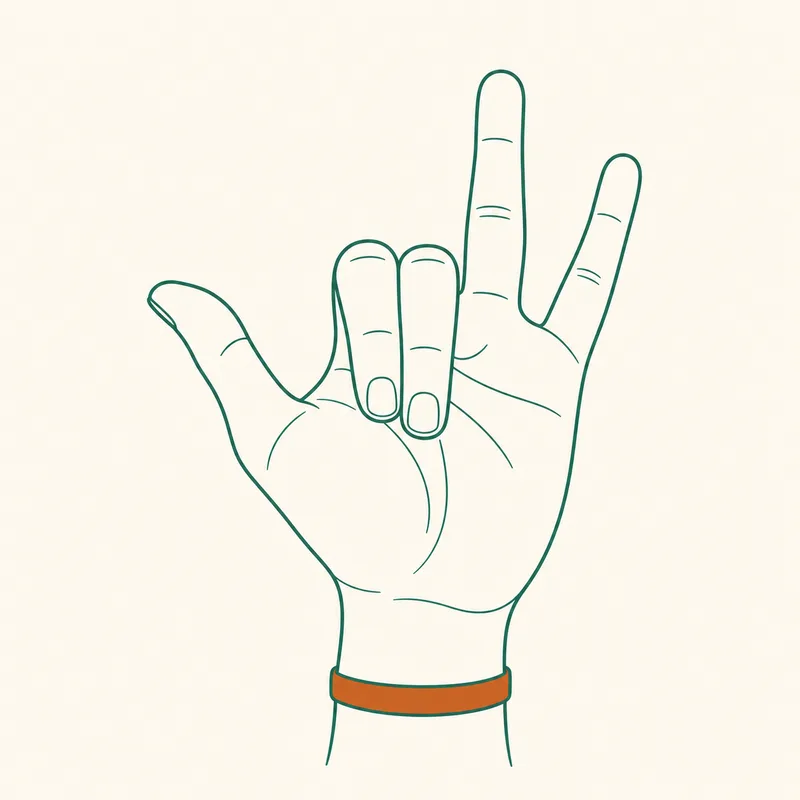
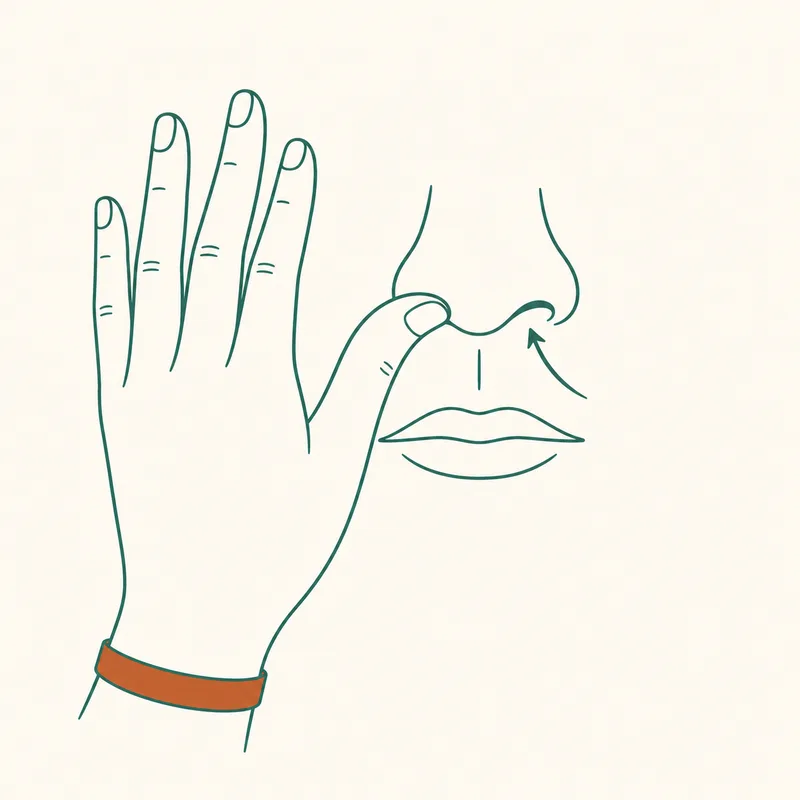
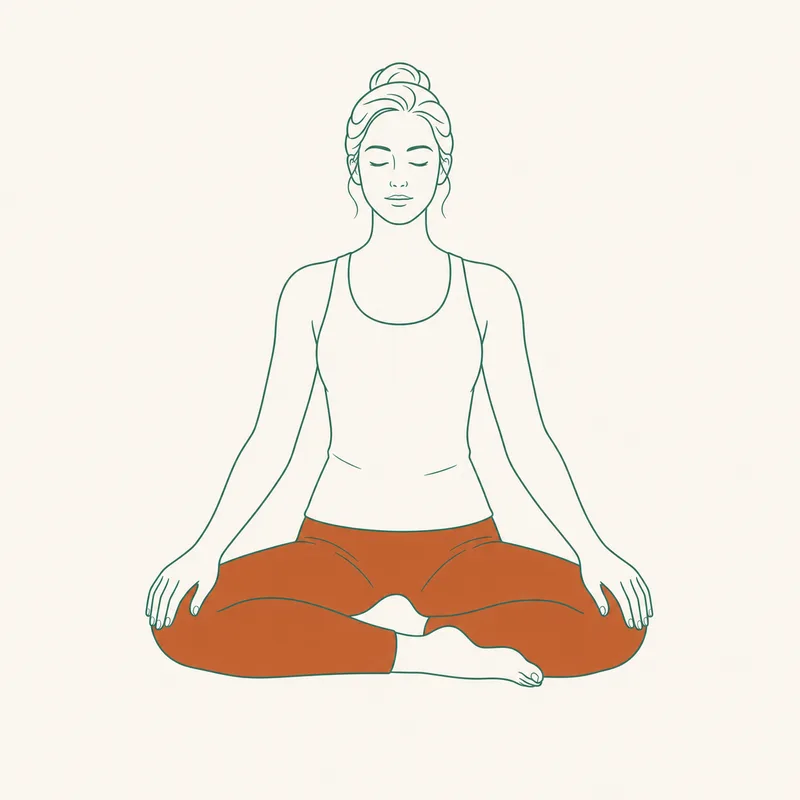
Practice
This player runs only the protocol marked as suitable for guidance. Stay within a comfortable range and stop at any warning sign above.
Alternate Nostril Breathing
Equal breath · no retention
Prepare
Sit comfortably. Soften the face and shoulders.
How to practise
Sit in a stable, comfortable position with the head, neck, and chest upright but not rigid. Let both arms and the jaw relax, then take two or three natural breaths.
Bring the right hand toward the nose. Use the thumb to close the right nostril and the ring finger to close the left; rest the other fingers comfortably rather than pressing the bridge or eyes.
Close the right nostril. Inhale gently through the left for a comfortable count—four is only a guide, not a target to force.
Close the left, release the right, and exhale through the right. Without holding, inhale again through the right.
Close the right, release the left, and exhale through the left. This completes one round.
Continue for six relaxed rounds, keeping inhalation and exhalation equally easy. Make the count shorter if the breath becomes rough, urgent, or noisy.
Finish after exhaling through the left. Lower the hand and let the breath return to its natural rhythm before standing or moving on.
Common mistakes
- Pressing hard on the nose, septum, or face instead of lightly sealing the nostril.
- Pulling air through a blocked nostril. A smaller, quiet breath—or pausing the practice—is safer than forcing airflow.
- Adding retention, bandhas, or a 1:4:2 ratio because they appear in classical instructions. These change the safety profile and are not part of this guided protocol.
- Overfilling the lungs or making the exhale last beyond comfort to match the count.
- Lifting the right shoulder and tiring the arm. Support the elbow if needed and keep the grip soft.
Variations by lineage
These differences are preserved rather than flattened into a single supposedly universal method.
Haṭha Yoga Pradīpikā
Verses 2.7–2.10 alternate the nostrils with breath retention and describe purification of the nāḍīs. This is materially more demanding than the no-retention beginner form guided here.
Svātmārāma, Haṭha Yoga Pradīpikā 2.7–2.10
Gheraṇḍa Saṃhitā
Chapter 5 teaches mantra-supported nāḍī purification with a 1:4:2 measure and later names repeated reversal through the nostrils anuloma-viloma. It belongs to a teacher-led, retention-based system, not this player protocol.
Gheraṇḍa Saṃhitā 5.33–45 and 5.53
Bihar School of Yoga
The practice is taught progressively: first learning the nostril sequence with an equal, comfortable breath, then introducing ratios and retention in later stages. The guided version on this page stays at the first, no-retention stage.
Swami Satyananda Saraswati, Asana Pranayama Mudra Bandha, “Nadi Shodhana Pranayama”
What the evidence says
Evidence for technique-specific health effects remains limited. Traditional claims describe a yoga framework; mechanistic findings explain a possible process; small clinical studies are not proof of treatment.
| Claim or finding | What it means | Citation |
|---|---|---|
| Traditional | ||
| Traditional texts present alternate-nostril practice as nāḍī purification and as preparation for deeper prāṇāyāma. | Nāḍīs belong to yoga’s subtle-body model; they should not be equated uncritically with anatomical nerves or blood vessels. | Haṭha Yoga Pradīpikā 2.7–2.10; Gheraṇḍa Saṃhitā 5.33–45 |
| Preliminary clinical | ||
| A small randomized pilot did not find a statistically significant between-group reduction in experimentally induced anxiety, although the authors reported a trend and called for a larger study. | This is a useful null/uncertain finding, not evidence that the practice treats anxiety. | Kamath A, Urval RP, Shenoy AK. Biomed Res Int. 2017;2017:2450670. doi:10.1155/2017/2450670 |
| In a four-week randomized study of 100 healthy students, most end-point differences between alternate-nostril breathing and control were not significant, despite within-group changes in several cardiorespiratory measures. | The narrow age range and mixed statistical picture limit generalization; it does not establish treatment effects. | Jahan I et al. Ann Afr Med. 2021;20(2):69–77. doi:10.4103/aam.aam_114_20 |
Sources
- 1.
Svātmārāma, Haṭha Yoga Pradīpikā
2.7–2.10
Alternate-nostril sequence with retention; cited as a historical instruction, not copied into the beginner player.
- 2.
Gheraṇḍa Saṃhitā
5.33–45 and 5.53
Mantra-based nāḍī purification, ratio, and an anuloma-viloma instruction.
- 3.
Swami Satyananda Saraswati, Asana Pranayama Mudra Bandha, 4th revised edition
Yoga Publications Trust, 2008; “Nadi Shodhana Pranayama”
A modern staged teaching reference; later stages are not implied to be beginner-safe.
- 4.
Kamath A, Urval RP, Shenoy AK. Effect of Alternate Nostril Breathing Exercise on Experimentally Induced Anxiety in Healthy Volunteers Using the Simulated Public Speaking Model: A Randomized Controlled Pilot Study.
Open reference ↗Randomized pilot with 30 healthy participants; no significant group effect on the mean anxiety scores.
- 5.
Jahan I et al. Effects of alternate nostril breathing exercise on cardiorespiratory functions in healthy young adults.
Open reference ↗Four-week randomized study in 100 healthy students; interpretation is limited by mostly non-significant between-group end-point differences.