Three-Part Breath
Literal meaning: Long or extended (breath)
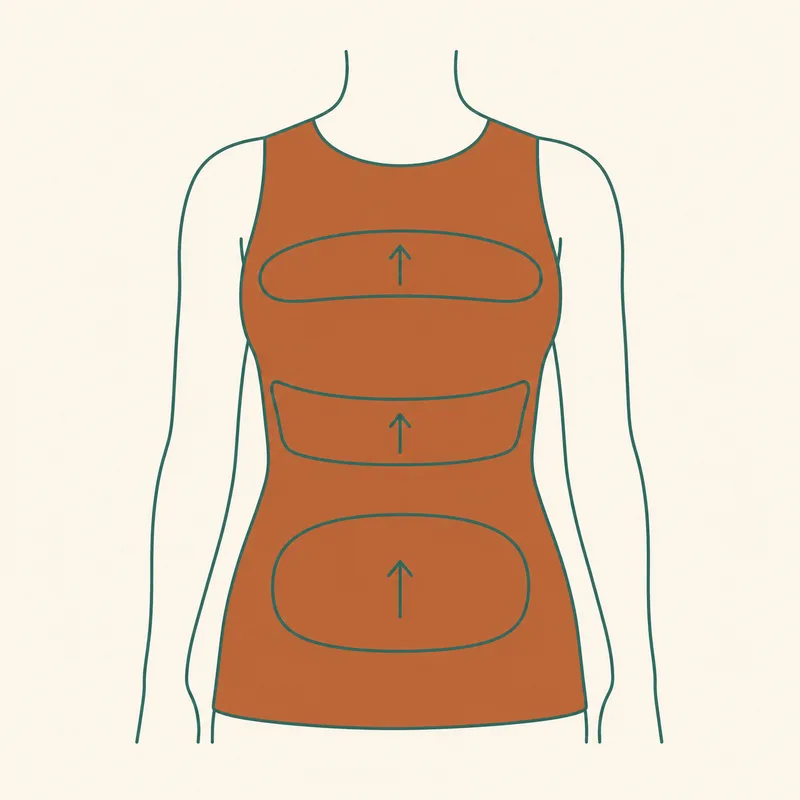
A slow, unforced breath that fills the body in three overlapping parts—belly, side ribs, then upper chest—and empties in reverse. It is the foundation most other pranayama is built upon. This page guides the gentle form only: smooth, comfortable, and with no breath retention.
Draft — pending review by a qualified teacher.
The safety framing and translations are editorial drafts. Read conservatively and do not treat this page as medical advice.
Author: Editorial draftReviewer: pendingLast reviewed: not yet reviewed
Who it’s for / not for
May suit
- Beginners who want to learn full, diaphragmatic breathing before trying any other pranayama.
- People who tend to breathe shallowly into the upper chest and want a slower, steadier rhythm.
- Practitioners looking for a quiet, grounding practice to settle before meditation, rest, or focused work.
- Anyone who wants to feel where their breath moves—belly, ribs, and chest—without holding or straining it.
Pause or seek guidance if
- Acute shortness of breath, a respiratory flare, or feeling unwell at rest
- Recent abdominal or chest surgery, an active hernia, or pain when the belly expands
- Later stages of pregnancy or a pregnancy with any complication
- A condition for which a clinician has advised limiting breath-control exercises
Safety
Use the gentlest form, keep every breath comfortable, and stop rather than pushing through symptoms.
Contraindications and cautions
Acute shortness of breath, a respiratory flare, or feeling unwell at rest
Do not use slow, paced breathing to push through active symptoms. Return to ordinary breathing and seek appropriate care.
Recent abdominal or chest surgery, an active hernia, or pain when the belly expands
Deep belly expansion may be uncomfortable or unsafe while healing. Keep the breath very small, or wait, until a clinician clears fuller breathing.
Later stages of pregnancy or a pregnancy with any complication
Keep the belly breath soft and never forced; sit or recline comfortably. If anything feels off, stop and check with your clinician.
A condition for which a clinician has advised limiting breath-control exercises
Ask the clinician who knows your condition whether this gentle, no-retention breathing is appropriate for you.
Stop if you feel…
- Dizziness, faintness, tingling, unusual breathlessness, or a strong urge to gasp.
- Chest pain, pressure, palpitations, or any new alarming symptom—stop and seek appropriate medical help.
- Belly or rib pain, anxiety that rises instead of settling, or a headache that begins or worsens during practice.
Read the Safety Center before practising retention or forceful breathwork.
Hand position & posture
Practice
This player runs only the protocol marked as suitable for guidance. Stay within a comfortable range and stop at any warning sign above.
Three-Part Breath
Gentle three-part breath
Prepare
Place one hand on the belly and let the body soften.
How to practise
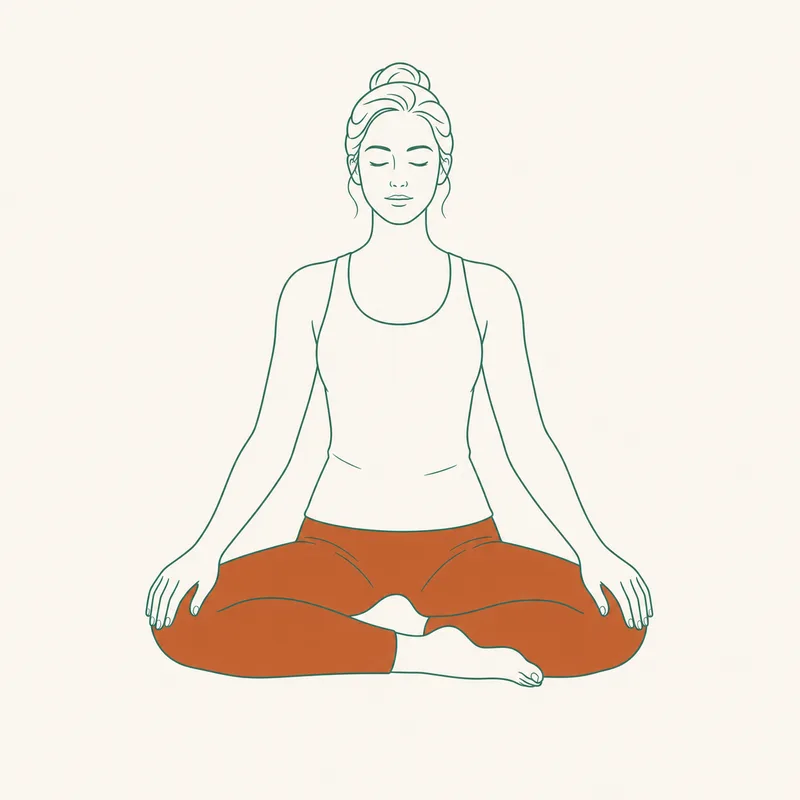
Sit comfortably with the spine tall but relaxed, or lie on your back with the knees supported. Rest one hand on the belly and, if you like, the other on the lower ribs.
Take a few natural breaths and simply notice where they move. Let the exhales lengthen a little on their own before you begin.
Begin the inhale by letting the belly rise first, so the hand on the belly moves outward. This is the diaphragmatic, lower part of the breath.
Continue the same inhale into the side and lower ribs, feeling them widen. Then let it rise gently into the upper chest to complete the breath.
Exhale in reverse: let the upper chest settle, then the ribs draw in, then the belly gently empties toward the spine—smoothly, without pushing.
Keep the whole cycle one continuous, quiet wave rather than three separate movements. Let inhale and exhale stay roughly equal and comfortable.
Continue for about eight relaxed rounds. If the breath feels tight, hungry for air, or effortful, make it smaller and slower rather than bigger.
To finish, release the effort and let the breath return to its own natural rhythm for a few moments before moving on.
Common mistakes
- Over-filling the lungs—gulping in as much air as possible. A comfortable, unhurried breath is the goal, not a maximal one.
- Reverse (paradoxical) breathing—pulling the belly in on the inhale and pushing it out on the exhale. The belly should gently rise as you breathe in.
- Lifting and tensing the shoulders to reach the upper-chest part. Let the chest fill from the ribs upward while the shoulders stay soft.
- Breaking the breath into three separate sniffs. The three parts overlap into one smooth, continuous flow.
- Straining to hit a count or holding the breath. In this gentle form there is no retention—if the count feels tight, shorten it.
Variations by lineage
These differences are preserved rather than flattened into a single supposedly universal method.
Bihar School of Yoga
Taught in stages as abdominal, thoracic, and clavicular breathing, which are then combined into a single flowing 'yogic breathing.' This is the same three-part structure guided here, learned one region at a time before joining them.
Swami Satyananda Saraswati, Asana Pranayama Mudra Bandha, “Yogic Breathing”
Iyengar tradition
Described as filling the lungs completely and evenly from the base upward, with careful attention to keeping the chest open and the throat and face relaxed. Iyengar treats full, even inhalation as the groundwork for all later prāṇāyāma.
B.K.S. Iyengar, Light on Prāṇāyāma
Yogi Ramacharaka (early modern)
Popularized in the West as 'the Complete Breath'—a single continuous inhalation drawing air into the lower, middle, and upper lungs in turn. It is an early printed description of the same full-breath idea, framed for a general audience.
Yogi Ramacharaka (W. W. Atkinson), Science of Breath (1904), “The Complete Breath”
What the evidence says
Evidence for technique-specific health effects remains limited. Traditional claims describe a yoga framework; mechanistic findings explain a possible process; small clinical studies are not proof of treatment.
| Claim or finding | What it means | Citation |
|---|---|---|
| Traditional | ||
| Modern yogic teaching presents full, three-part breathing as the foundational skill on which other prāṇāyāma techniques are built. | The 'three-part' framing is a modern pedagogical description; classical texts speak of full or complete yogic breathing rather than counting parts. | Swami Satyananda Saraswati, Asana Pranayama Mudra Bandha, “Yogic Breathing”; B.K.S. Iyengar, Light on Prāṇāyāma |
| Mechanistic | ||
| Slow, diaphragm-led breathing increases the depth of each breath and tends to shift autonomic balance toward parasympathetic (vagal) activity, which is often felt as calming. | This describes general, well-established respiratory physiology, not a treatment effect for any specific condition. | Zaccaro A, Piarulli A, Laurino M, et al. Front Hum Neurosci. 2018;12:353. doi:10.3389/fnhum.2018.00353 |
| Preliminary clinical | ||
| A small randomized study of 40 healthy adults found that an intensive 8-week, device-guided diaphragmatic breathing program was associated with lower salivary cortisol and improved sustained attention and negative affect versus a control group. | Small sample of healthy volunteers and an intensive, feedback-device protocol very different from a few casual minutes of this breath; it does not show the practice treats any condition. | Ma X, Yue Z-Q, Gong Z-Q, et al. Front Psychol. 2017;8:874. doi:10.3389/fpsyg.2017.00874 |
Sources
- 1.
Swami Satyananda Saraswati, Asana Pranayama Mudra Bandha, 4th revised edition
Yoga Publications Trust, 2008; “Yogic Breathing” (abdominal, thoracic, clavicular, and full yogic breathing)
A modern staged teaching of the three-part / full yogic breath used as the base for later practices.
- 2.
B.K.S. Iyengar, Light on Prāṇāyāma
HarperCollins; sections on full inhalation and the technique of complete breathing
Treats full, even inhalation as groundwork; emphasizes an open chest and a relaxed throat and face.
- 3.
Yogi Ramacharaka (W. W. Atkinson), Science of Breath
1904; “The Complete Breath”
An early printed description of a single continuous breath filling the lower, middle, and upper lungs; historical context, not a safety authority.
- 4.
Ma X, Yue Z-Q, Gong Z-Q, et al. The Effect of Diaphragmatic Breathing on Attention, Negative Affect and Stress in Healthy Adults.
Open reference ↗Small randomized study (n=40) of an intensive 8-week diaphragmatic breathing program; findings are preliminary and specific to that protocol.