Equal / Box Breathing
Literal meaning: Equal movement (of the breath)
A steadying practice built on one idea: make the parts of the breath equal in length. This page guides a gentle four-count rhythm in which the pauses are kept soft and optional; the firmer "box" form with full retention, and unequal (viṣama) ratios, belong to a teacher-led progression.
Draft — pending review by a qualified teacher.
The safety framing and translations are editorial drafts. Read conservatively and do not treat this page as medical advice.
Author: Editorial draftReviewer: pendingLast reviewed: not yet reviewed
Who it’s for / not for
May suit
- People who want a simple, memorable way to slow and steady the breath before focused work or sleep.
- Beginners who find counting a helpful anchor and can breathe comfortably without straining to fill or empty the lungs.
- Practitioners noticing an uneven, hurried breath who want to gently even out inhalation and exhalation.
- Anyone seeking a calm, low-intensity reset during a stressful moment—without breath-holding as the goal.
Pause or seek guidance if
- Acute shortness of breath, a respiratory flare, chest pain, or feeling unwell at rest
- Pregnancy, uncontrolled high blood pressure, cardiovascular or seizure conditions, or raised eye pressure (e.g. glaucoma)
- Anxiety or panic that is triggered by focusing on the breath or by holding it
- A condition for which a clinician has advised limiting breath-control or breath-holding exercises
Safety
Use the gentlest form, keep every breath comfortable, and stop rather than pushing through symptoms.
Contraindications and cautions
Acute shortness of breath, a respiratory flare, chest pain, or feeling unwell at rest
Do not use paced breathing or pauses to push through active symptoms. Return to ordinary breathing and seek appropriate care.
Pregnancy, uncontrolled high blood pressure, cardiovascular or seizure conditions, or raised eye pressure (e.g. glaucoma)
Even the light pauses here are a form of breath retention. Skip the holds and keep only the equal inhale and exhale, or check with your clinician first.
Anxiety or panic that is triggered by focusing on the breath or by holding it
For some people counting and pausing increase unease. Let the breath be natural, or drop the pauses and keep the rhythm gentle.
A condition for which a clinician has advised limiting breath-control or breath-holding exercises
Ask the clinician who knows your situation whether this gentle equal-breath version, with or without the pauses, is appropriate.
Stop if you feel…
- Dizziness, faintness, tingling, air hunger, or a strong urge to gasp—stop and let the breath return to normal.
- Chest pain or pressure, palpitations, or any new alarming symptom—stop and seek appropriate medical help.
- Rising anxiety, panic, or a headache that begins or worsens during the practice.
Read the Safety Center before practising retention or forceful breathwork.
Hand position & posture
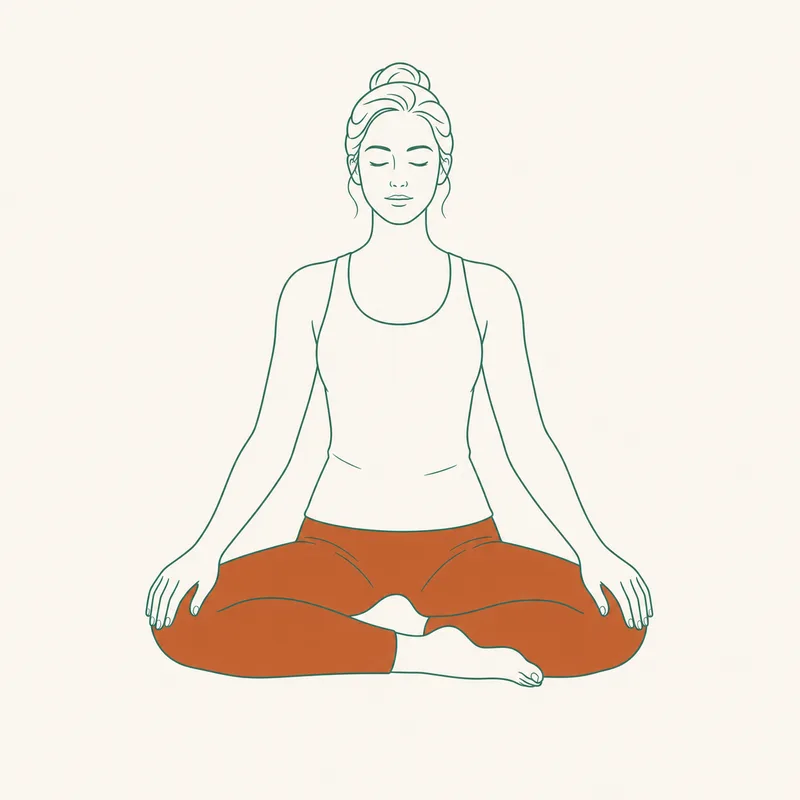
Practice
This player runs only the protocol marked as suitable for guidance. Stay within a comfortable range and stop at any warning sign above.
Equal / Box Breathing
Gentle four-count box
Prepare
Settle into a comfortable seat and soften your breath.
How to practise
Sit in a stable, comfortable position with the spine upright but not rigid. Let the shoulders, jaw, and hands relax, and take a few natural breaths without counting.
Choose a count that feels easy—four is a common starting point. The aim is a length you can repeat calmly, not the longest count you can manage.
Inhale smoothly through the nose for the full count, letting the breath be quiet and even.
Pause gently for the same count with the breath in. Keep the throat and belly soft; if a pause feels tight, shorten it or let it go entirely.
Exhale slowly through the nose for the same count, releasing without pushing the air out.
Pause gently again with the breath out for the same count, then let the next inhale begin on its own.
Continue for six calm rounds. Keep every part equal and easy; if any part becomes rushed, strained, or noisy, shorten the count or drop the pauses.
Finish after an exhale and let the breath return to its natural rhythm before standing or moving on.
Common mistakes
- Choosing a count that is too long, so the breath becomes forced, jerky, or gasping. A shorter, smooth count is always better than a long, strained one.
- Holding the breath hard or making the pauses long to "complete the box." The pauses here are soft and optional; retention is not the goal of this guided form.
- Overfilling the lungs on the inhale or squeezing the exhale to the very end, which strains the breath instead of steadying it.
- Tensing the face, throat, or shoulders while concentrating on the count. Let the counting stay light and the body soft.
- Pushing on through dizziness or air hunger to keep the rhythm. If either appears, return to easy, natural breathing.
Variations by lineage
These differences are preserved rather than flattened into a single supposedly universal method.
Bihar School of Yoga
The simplest form makes only the inhalation and exhalation equal, with no breath-holding. This is the safest entry point and matches the no-retention rhythm most beginners are taught first.
Swami Satyananda Saraswati, Asana Pranayama Mudra Bandha, Yoga Publications Trust
Iyengar tradition
In sama vṛtti prāṇāyāma the same measure is extended to the retentions (antara and bāhya kumbhaka) so that inhalation, hold-in, exhalation, and hold-out are all equal—the classical basis of the four-part "box." Iyengar treats this retention form as advanced and to be added only under guidance.
B.K.S. Iyengar, Light on Prāṇāyāma, Vṛtti Prāṇāyāma
Iyengar tradition
Viṣama vṛtti is the deliberate opposite: the parts of the breath are made unequal (for example a longer exhalation or retention). It is a more demanding progression from the equal form and should not be confused with the steady, balanced rhythm on this page.
B.K.S. Iyengar, Light on Prāṇāyāma, Vṛtti Prāṇāyāma
What the evidence says
Evidence for technique-specific health effects remains limited. Traditional claims describe a yoga framework; mechanistic findings explain a possible process; small clinical studies are not proof of treatment.
| Claim or finding | What it means | Citation |
|---|---|---|
| Traditional | ||
| Classical and modern yoga texts present equal-length breathing (sama vṛtti) as a foundational way to steady and refine the breath before attempting uneven ratios or retention. | This is a traditional teaching about how to train the breath, not a medical claim about treating any condition. | B.K.S. Iyengar, Light on Prāṇāyāma, Vṛtti Prāṇāyāma |
| Mechanistic | ||
| Deliberately slow, paced breathing near five to six breaths per minute is associated in physiological studies with increased heart-rate variability, thought to involve the baroreflex and respiratory sinus arrhythmia. | These are acute, largely short-term physiological shifts that vary between individuals; they describe a plausible mechanism, not a proven treatment effect. | Zaccaro A et al. Front Hum Neurosci. 2018;12:353. doi:10.3389/fnhum.2018.00353 |
| Preliminary clinical | ||
| In a controlled study, a single session of slow-paced breathing at six cycles per minute raised a vagal heart-rate-variability index (RMSSD) immediately afterward, with similar effects whether or not biofeedback was added. | This reflects an acute physiological response in study conditions, not evidence that the practice treats anxiety, blood pressure, or any medical condition. | Laborde S et al. Psychophysiology. 2022;59(1):e13952. doi:10.1111/psyp.13952 |
Sources
- 1.
Swami Satyananda Saraswati, Asana Pranayama Mudra Bandha, 4th revised edition
Yoga Publications Trust, 2008; pranayama section on equal breathing
A modern staged teaching reference in which equal inhalation and exhalation is learned before retention is introduced.
- 2.
B.K.S. Iyengar, Light on Prāṇāyāma
HarperCollins; chapters on Vṛtti Prāṇāyāma (Sama and Viṣama Vṛtti)
Describes sama vṛtti (equal) and viṣama vṛtti (unequal) breathing, and treats the retention-based equal form as advanced.
- 3.
Zaccaro A, Piarulli A, Laurino M, et al. How Breath-Control Can Change Your Life: A Systematic Review on Psycho-Physiological Correlates of Slow Breathing.
Open reference ↗Systematic review of slow breathing (under ~10 breaths/min) reporting associations with autonomic and HRV changes; mechanistic support, not proof of clinical benefit.
- 4.
Laborde S, Allen MS, Borges U, et al. Psychophysiological effects of slow-paced breathing at six cycles per minute with or without heart rate variability biofeedback.
Open reference ↗Controlled study in 112 participants; a single slow-paced-breathing session acutely raised RMSSD, with no added benefit from biofeedback.