Relaxing Breath
Literal meaning: The four-seven-eight relaxing breath
A modern relaxation breath — popularized by Dr. Andrew Weil — that pairs a short inhale, a held breath, and a longer, complete exhale. Because it includes a breath-hold (retention), it asks for more care than a simple long-exhale practice: sit or lie down, begin with only a few rounds, and let the counts be loose. This page keeps the rhythm gentle; the hold is optional and any light-headedness means stop.
Draft — pending review by a qualified teacher.
The safety framing and translations are editorial drafts. Read conservatively and do not treat this page as medical advice.
Author: Editorial draftReviewer: pendingLast reviewed: not yet reviewed
Who it’s for / not for
May suit
- People winding down at the end of the day or preparing the body for rest and sleep.
- Those who like a clear, counted structure and can breathe comfortably through the nose.
- Practitioners already at ease with slow breathing who want to add a short, comfortable pause.
- Anyone who can sit or lie down undistracted — this is not a practice to do while driving or active.
Pause or seek guidance if
- Pregnancy
- Cardiovascular conditions — including uncontrolled high blood pressure, heart disease, or a history of arrhythmia
- Respiratory conditions such as asthma or COPD, or any acute breathlessness
- Raised intraocular or intracranial pressure — for example glaucoma, or recent eye, ear, or head surgery
Safety
Use the gentlest form, keep every breath comfortable, and stop rather than pushing through symptoms.
Contraindications and cautions
Pregnancy
Breath retention is generally discouraged in pregnancy. If you wish to practise, keep to a gentle long exhale without the hold, and check first with a clinician or an experienced prenatal yoga teacher.
Cardiovascular conditions — including uncontrolled high blood pressure, heart disease, or a history of arrhythmia
Holding the breath can transiently change heart rate and blood pressure. Ask the clinician who knows your heart whether a short-hold practice is appropriate, or use only the no-retention version.
Respiratory conditions such as asthma or COPD, or any acute breathlessness
Retention and a paced count can feel uncomfortable or trigger air hunger. Do not push through symptoms; drop the hold, return to natural breathing, and seek guidance if in doubt.
Raised intraocular or intracranial pressure — for example glaucoma, or recent eye, ear, or head surgery
Breath-holding can raise internal pressures. Avoid the retention entirely in these situations unless a clinician who knows your case has specifically cleared it.
Stop if you feel…
- Dizziness, light-headedness, faintness, tingling, or a strong urge to gasp — release the hold, breathe naturally, and do fewer rounds next time.
- Chest pain or pressure, palpitations, or any new alarming symptom — stop and seek appropriate medical help.
- Rising anxiety, panic, or a headache that begins or worsens during the practice — end the session and return to easy, natural breathing.
Read the Safety Center before practising retention or forceful breathwork.
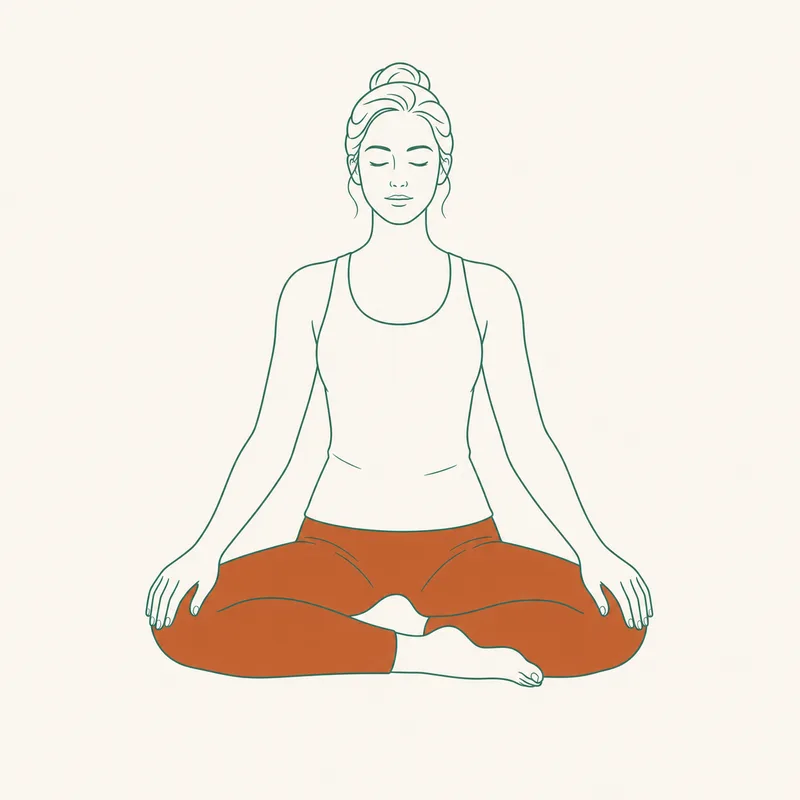
Hand position & posture
Practice
This player runs only the protocol marked as suitable for guidance. Stay within a comfortable range and stop at any warning sign above.
Relaxing Breath
Gentle 4 · 7 · 8 breath
Prepare
Sit or lie down comfortably. Let the breath be easy — never strain to keep the count.
How to practise
Sit or lie down where you can stay undistracted for a few minutes. Let the shoulders, jaw, and belly soften, and take two or three natural breaths first.
If you like, rest the tip of the tongue lightly behind the upper front teeth, as Dr. Weil describes. This is a comfort cue, not a requirement.
Breathe in quietly through the nose for a comfortable count of about four. Four is only a guide — do not overfill the lungs to reach it.
Let the breath rest in for a gentle pause of up to about seven. Keep the throat and face soft; if the hold feels tight, shorten it or skip it entirely.
Exhale slowly and completely through the mouth for about a count of eight, letting it be a soft, unhurried release rather than a forced push.
That is one round. Begin with only up to four rounds — this small starting dose is the technique's own recommendation for at least the first weeks.
If any count feels forced, drop the numbers and simply keep the exhale a little longer than the inhale. A comfortable breath always comes before the counting.
Finish after an exhale. Let the breath return to its natural rhythm and stay seated or lying for a few moments before standing up.
Common mistakes
- Chasing the numbers — inhaling too deeply or dragging out the hold to hit exactly 4-7-8. The counts are a shape, not a target; ease matters more than accuracy.
- Doing too many rounds too soon. Beginning with more than four rounds is a common way to feel light-headed; build up slowly, if at all.
- Straining or bracing during the 7-count hold. Retention should feel like a soft pause, not a struggle to keep the air in.
- Practising while active or driving. The hold and the settling effect make this a seated or lying-down practice only.
- Forcing a loud, hard exhale. The out-breath is long and complete but soft — a squeezed, effortful push tires the chest and defeats the calming purpose.
Variations by lineage
These differences are preserved rather than flattened into a single supposedly universal method.
Modern popularization (Dr. Andrew Weil)
The canonical 4-7-8: inhale through the nose to four, hold for seven, and exhale through the mouth with a soft "whoosh" to eight, with the tongue tip resting behind the upper teeth. Weil advises no more than four rounds at a time for the first month before slowly extending.
Andrew Weil, MD — "4-7-8 (Relaxing) Breath" (drweil.com / Arizona Center for Integrative Medicine)
Classical ratio prāṇāyāma
Traditional texts and modern teachers describe measured breathing in ratios of inhalation : retention : exhalation (a commonly cited proportion is 1:4:2). The 4-7-8 pattern is a gentler, fixed-second cousin of this idea — the longer exhale and short hold echo classical ratio breathing rather than copying any one verse.
B.K.S. Iyengar, Light on Prāṇāyāma; Gheraṇḍa Saṃhitā, Chapter 5
Therapeutic no-retention adaptation
For anyone who finds the seven-count hold uncomfortable — or for whom retention is discouraged — drop the hold and simply keep the exhale longer than the inhale (for example, in for four, out for six or eight). This removes the retention safety concern while keeping the calming extended exhale.
Common clinical / therapeutic teaching adaptation
What the evidence says
Evidence for technique-specific health effects remains limited. Traditional claims describe a yoga framework; mechanistic findings explain a possible process; small clinical studies are not proof of treatment.
| Claim or finding | What it means | Citation |
|---|---|---|
| Mechanistic | ||
| A slow, complete exhale that is longer than the inhale, together with a paced rhythm, tends to bias the autonomic nervous system toward its calming (parasympathetic) side. This is a well-established feature of slow breathing generally. | This describes a general physiological tendency, not a proven treatment effect for any specific condition. | Zaccaro A, Piarulli A, Laurino M, et al. Front Hum Neurosci. 2018;12:353. doi:10.3389/fnhum.2018.00353 |
| Preliminary clinical | ||
| In a small physiological study, a single acute session of 4-7-8 breathing was followed by a significant drop in heart rate and systolic blood pressure and a shift in heart-rate-variability markers, in both rested and sleep-deprived young adults. | This was a small (n=43), non-randomized, mostly-female sample measuring immediate within-session changes only. It does not show lasting benefit or treatment of any condition. | Vierra J, Boonla O, Prasertsri P. Physiol Rep. 2022;10(13):e15389. doi:10.14814/phy2.15389 |
| When compared head-to-head, 4-7-8 breathing was not superior for calming: breathing at about six breaths per minute raised heart-rate-variability more, and none of the tested patterns meaningfully changed blood pressure or mood. | A useful, honest comparison: 4-7-8 is a reasonable relaxation tool, but this within-subject study (n=84) suggests it is not uniquely powerful, and simpler slow breathing may raise HRV more. | Marchant J, Khazan I, Cressman M, Steffen P. Appl Psychophysiol Biofeedback. 2025;50(2):261–276. doi:10.1007/s10484-025-09688-z |
Sources
- 1.
Andrew Weil, MD. "Three Breathing Exercises" / "4-7-8 (Relaxing) Breath."
drweil.com; Arizona Center for Integrative Medicine
The modern origin of the 4-7-8 pattern, including the tongue placement, whoosh exhale, and the advice to keep to four rounds at first.
- 2.
B.K.S. Iyengar. Light on Prāṇāyāma (Prāṇāyāma Dīpikā).
HarperCollins; on pūraka, kumbhaka, rechaka and cautions on retention
Classical framing of ratio breathing and clear warnings that retention (kumbhaka) is demanding and should be approached gradually and under guidance.
- 3.
Swami Satyananda Saraswati. Asana Pranayama Mudra Bandha.
Yoga Publications Trust, 2008; sections on prāṇāyāma ratios and kumbhaka
A modern staged reference; retention and fixed ratios are taught only after comfortable slow breathing is established, not as a first step.
- 4.
Vierra J, Boonla O, Prasertsri P. Effects of sleep deprivation and 4-7-8 breathing control on heart rate variability, blood pressure, blood glucose, and endothelial function in healthy young adults.
Open reference ↗Non-randomized study of 43 young adults; acute within-session decreases in heart rate and systolic blood pressure after a single 4-7-8 session.
- 5.
Marchant J, Khazan I, Cressman M, Steffen P. Comparing the Effects of Square, 4-7-8, and 6 Breaths-per-Minute Breathing Conditions on Heart Rate Variability, CO2 Levels, and Mood.
Open reference ↗Within-subject study of 84 students; 4-7-8 was not superior, and slower six-breaths-per-minute breathing raised HRV more, with no meaningful blood pressure or mood change.
- 6.
Aktaş GK, İlgin VE. The Effect of Deep Breathing Exercise and 4-7-8 Breathing Techniques Applied to Patients After Bariatric Surgery on Anxiety and Quality of Life.
Obes Surg. 2023. https://doi.org/10.1007/s11695-022-06405-1
Randomized controlled trial (n=90) in post-surgical patients; the 4-7-8 group had lower post-test state-anxiety scores. Findings are specific to this surgical population and should not be generalized.